
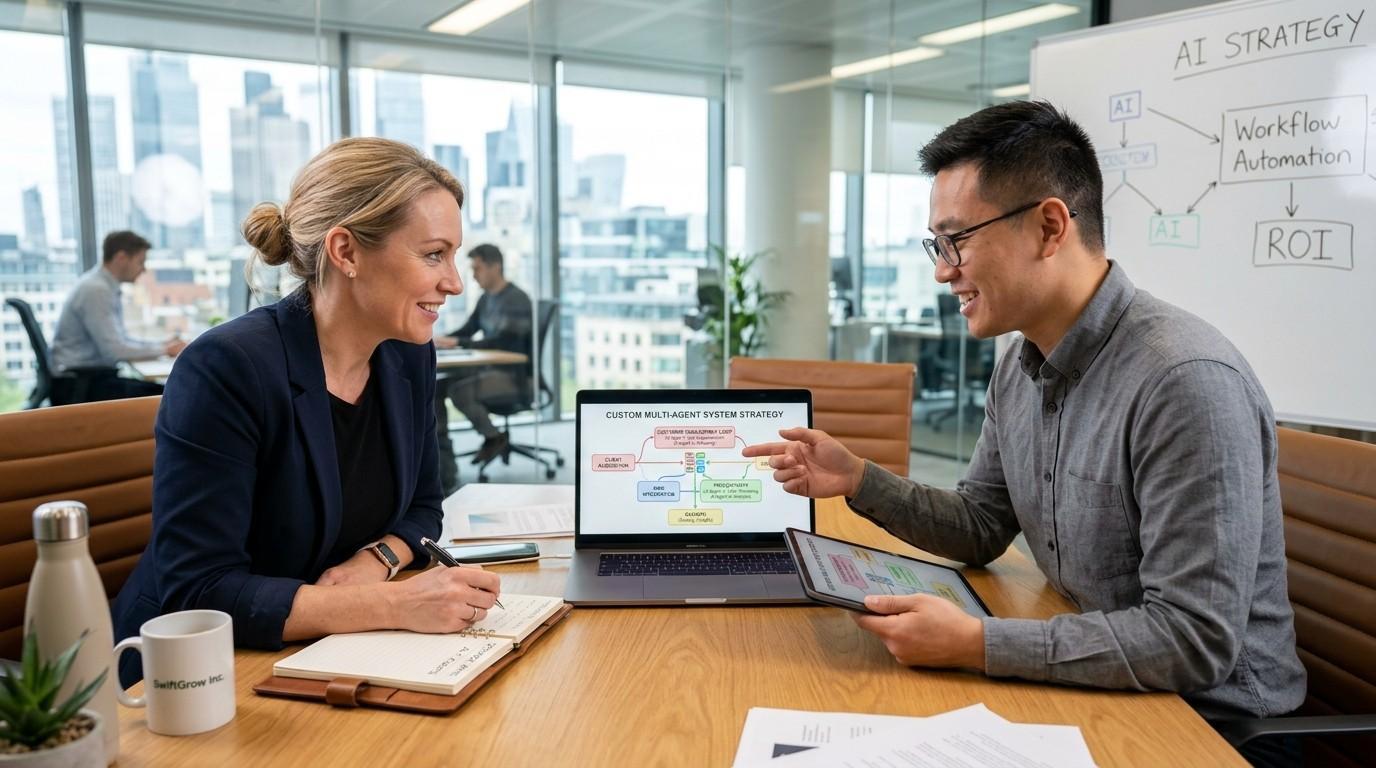
Artificial intelligence is moving beyond chatbots and virtual assistants. Businesses are now adopting multi agent system to complete work that previously required entire teams.
The growing popularity of these intelligent systems comes from their ability to solve complex problems. As organisations deal with larger datasets, more customer interactions, and increasingly complex workflows, a single AI agent often struggles to maintain accuracy and consistency. Multiple agent systems overcome this limitation by dividing responsibilities across different agents with clearly defined objectives.
For businesses, this shift presents a significant opportunity. Thanks to no-code platforms and modern agent frameworks, building multi-agent systems no longer requires advanced software development expertise. Organisations can now create sophisticated AI-powered workflows using visual interfaces, pre-built integrations, and configurable automation tools.
At Smart Digitants, we help businesses implement AI agents that streamline operations, improve customer engagement, and support sustainable growth.
Multi-Agent Systems Explained: What They Are and Why Businesses Need Them
A multi-agent system is a collection of independent agents that interact within a shared environment to achieve individual and collective goals. Unlike single agent systems, where one AI model performs every task, a multi-agent system consists of multiple autonomous agents that collaborate, communicate, and make decisions based on their assigned responsibilities.
Each agent in a MAS works with local information and has its own objectives. These agents can be software programs, bots, or physical robots. In business environments, they are usually software agents powered by large language models and automation platforms.
To understand how multi agent systems work, imagine a customer enquiry arriving through your website. A single agent approach would require one AI model to:
- Understand the enquiry
- Retrieve relevant information
- Assess urgency
- Draft a response
- Update the CRM
In contrast, a multi-agent system divides these activities among specialised AI agents. For example:
- A routing agent analyses the user request.
- A customer service agent answers common questions.
- A research agent retrieves information from internal databases.
- A CRM agent updates customer records.
- A reporting agent logs performance metrics.
Because each agent is designed for specific tasks enhancing functional specialisation, the overall system becomes more accurate and reliable. The core mechanism of a multi-agent system relies on decentralised intelligence and cooperation.
This approach mirrors how human teams operate. Rather than expecting one employee to handle every responsibility, organisations assign different tasks to specialists. AI agents collaborate in much the same way. Multi-agent systems can divide complex tasks among specialised agents working in parallel. Specialised agents in MAS can improve accuracy by cross-checking each other’s outputs.
As a result, businesses gain several advantages:
- Faster decision making
- Better operational efficiency
- Improved customer experiences
- Reduced manual workload
- Greater scalability
Agents and multi-agent systems enhance problem-solving through collaboration. They are scalable, allowing more agents without slowing down. This scalability is particularly important for growing businesses that are already investing in enterprise chatbot development services. As demand increases, organisations can add more agents without redesigning the entire system.
Today’s multi-agent AI systems are already being used in supply chains, financial services, healthcare, transportation management, and automated customer support. They aid in disease prediction and prevention in healthcare. Multi-agent systems support financial services like fraud monitoring. They are applied in automated driving systems for traffic simulation and enhance supply chain management efficiency.
The ability to coordinate multiple AI agents is rapidly becoming a competitive advantage for organisations looking to automate complex workflows without increasing headcount. However, UK businesses serving European customers should also monitor emerging AI regulations that may affect their operations.
Core Components of a Multi-Agent System
Building a successful multi-agent system requires more than connecting a few AI tools together. Whether you are using a no-code platform or a custom agent framework, every effective agent system relies on several foundational components that enable agents to communicate, collaborate, and make decisions reliably.
Before implementation, it is important to define the problem and goals before implementation. This ensures every agent contributes to measurable business outcomes rather than creating unnecessary complexity.
AI Agents and Specialised Responsibilities
At the heart of every multi-agent system are AI agents. These are autonomous software entities designed to perform specific tasks within the broader workflow.
Unlike a single AI agent that attempts to handle everything, a multi-agent framework distributes responsibilities across multiple agents. Each agent focuses on a narrow function, which improves efficiency and reduces errors.
For example, a sales automation system might include:
- A lead qualification agent
- A research agent
- A proposal generation agent
- A customer communication agent
- A reporting agent
Each agent is designed for specific tasks enhancing functional specialisation.
This approach allows specialised AI agents to develop expertise within their assigned areas. Rather than competing for the same responsibilities, different agents work together to achieve a common objective.
In many organisations, intelligent agents now assist with software development, engineering assistance, generating code suggestions, writing code, analysing customer data, and handling support requests. Businesses can also configure specialised model types for different workloads depending on accuracy and performance requirements, especially when these agents are powered by conversational AI technologies.
Shared Knowledge and Data Access
A multi-agent system is only as effective as the information available to its agents. To perform their duties, agents access a shared environment that may include:
- CRM platforms
- Internal documentation
- Customer databases
- Knowledge bases
- Project management systems
- Marketing analytics tools
The shared environment ensures individual agents can access relevant information without duplicating data sources. For example, when a customer submits a request, one agent may retrieve account information while another accesses previous interactions, much like automation chatbot integrations with CRM and ERP systems. This enables agents work collaboratively while maintaining consistency across the entire system.
Context engineering plays a crucial role here. The right information must be delivered to the right agent at the right time. Poor context management often leads to inaccurate responses, duplicated effort, or conflicting recommendations.
Agent Communication and Coordination
One of the defining characteristics of a multi-agent system is agent communication. Agents in multi-agent systems communicate using defined protocols. Agents in a MAS communicate using standardised messaging languages. In practice, businesses commonly use communication protocols like JSON or XML for agent interaction.
These communication protocols allow multiple AI agents to exchange structured information and coordinate activities effectively. For example:
- A lead qualification agent passes prospect data to a sales agent.
- A support agent sends unresolved issues to a specialist agent.
- A research agent delivers findings to a reporting agent.
Without effective agent communication, even highly capable autonomous agents struggle to cooperate efficiently. As the number of agents increases, communication and coordination in multi-agent systems become complex as the number of agents increases.
Communication overhead can occur in multi-agent systems due to high message volume. This is one reason why organisations should carefully design communication pathways before deploying large-scale multi-agent AI systems.
Decision Making and Governance
Effective decision making separates successful multi-agent systems from poorly managed automation projects. Every agent should operate within clearly defined rules and boundaries. Businesses must establish:
- Approval workflows
- Escalation paths
- Access permissions
- Performance thresholds
- Human review checkpoints
Although autonomous systems can perform many actions independently, certain activities still require human oversight. For example:
- Contract approvals
- Financial transactions
- Compliance reviews
- Strategic recommendations
This human-in-the-loop approach helps prevent errors and ensures accountability. Testing is crucial to ensure agents meet expected behaviours. Organisations should regularly evaluate agent behaviours, monitor tool usage, review tool calls, and analyse past bugs to identify opportunities for improvement.
As businesses begin developing agents at scale, governance becomes increasingly important. Agent malfunctions can lead to system-wide failures in multi-agent systems. Unpredictable behaviour can complicate multi-agent system management.
By establishing clear controls from the outset, businesses can build a multi-agent system that remains reliable, secure, and aligned with organisational goals. Understanding these core components provides the foundation for implementation. The next step is choosing the right AI architecture that determines how agents collaborate across the business.
How to Build a Multi Agent AI System Without Coding

Until recently, building multi-agent systems required specialist software development teams, extensive programming knowledge, and significant infrastructure investment. Today, no-code and low-code platforms have changed that reality. Businesses can now deploy a sophisticated multi-agent system using visual workflow builders, pre-built integrations, and configurable AI agents without writing a single line of code.
The key is not the technology itself. Success depends on designing a system that aligns with business objectives, customer needs, and operational processes.
Step 1: Identify Processes Suitable for Automation
Before selecting tools or creating agents, organisations should identify where a multi-agent system can deliver measurable value. The most effective starting points are often repetitive, rules-based processes involving large volumes of data or customer interactions.
Examples include:
- Lead qualification and nurturing
- Customer support workflows
- Appointment scheduling
- Internal knowledge management
- Marketing content production
- Reporting and analytics
- Employee onboarding
A common mistake is attempting to automate everything at once. Instead, focus on one business challenge where multiple AI agents can work together to improve outcomes. Remember to define the problem and goals before implementation. Clear objectives help determine how many agents are required and what success looks like.
Step 2: Design Your AI Agent Roles
Once the business process is identified, the next step is defining agent responsibilities. A successful multi-agent system relies on specialised agents rather than one agent trying to perform every function.
Each agent should have a clearly defined purpose, required inputs, expected outputs, and decision boundaries. This separation allows multiple agents to focus on specific tasks while reducing overlap and improving efficiency.
Step 3: Select a No-Code Multi-Agent Platform
The technology stack you choose plays a significant role in how effectively your multi-agent system operates. When evaluating platforms, look for:
- Visual workflow builders
- AI agent orchestration capabilities
- Knowledge base integrations
- CRM connectivity
- API support
- Context management features
- Monitoring and analytics
Many modern agentic AI systems also support retrieval-augmented generation, workflow automation, and model context protocol integrations that help agents maintain consistency across complex workflows. Discover how Model Context Protocol (MCP) connects AI models with external tools and live data in our guide.
Businesses that are comparing the best AI chatbot apps should prioritise platforms that make agent communication easy to configure without requiring engineering expertise.
Although traditional frameworks like JADE and Mesa aid in multi-agent system development, many organisations now prefer no-code alternatives that reduce technical complexity and accelerate deployment.
Step 4: Connect Business Data and Knowledge Sources
Even the most capable AI agents are ineffective without access to relevant information. The next stage involves connecting your multi-agent system to business data sources. Common AI web integrations include:
- CRM platforms
- Product catalogues
- Internal documentation
- Customer support systems
- Marketing platforms
- Databases
- Shared drives
This creates a shared environment where different agents can access accurate and up-to-date information. For example, when a customer submits a query, a support agent may retrieve information from a knowledge base while another agent accesses CRM records to personalise the response.
Because each agent in a MAS works with local information and has its own objectives, data accessibility and context quality directly influence performance. Strong context engineering ensures agents receive only relevant information, helping improve accuracy and reduce unnecessary processing.
Step 5: Build Workflows and Agent Interactions
At this stage, businesses begin defining how agents collaborate. Multi-agent systems consist of multiple autonomous agents, but those agents still require structured workflows to coordinate their activities.
A typical workflow might look like this:
- A user request enters the system.
- A routing agent determines intent.
- The request is assigned to the appropriate specialised agent.
- Additional agents contribute information or perform supporting tasks.
- Results are consolidated and delivered to the user.
- Reporting agents record outcomes and performance metrics.
Agents in multi-agent systems communicate using defined protocols. Many organisations use communication protocols like JSON or XML for agent interaction because they provide consistency and compatibility across systems.
As more agents are added, coordination complexity becomes increasingly important. Complexity in coordination can arise from the need to prevent conflicting actions among agents. Clearly defined workflows reduce these risks and improve reliability.
Step 6: Test, Monitor, and Optimise Continuously
Launching a multi-agent system is only the beginning. Testing is crucial to ensure agents meet expected behaviours. Every workflow should be evaluated against real-world scenarios before full deployment. Key areas to monitor include:
- Accuracy
- Response quality
- Task completion rates
- Agent communication effectiveness
- User satisfaction
- Latency
- Error rates
Businesses should also analyse past bugs, review agent behaviours, and identify opportunities for refinement. One advantage of multi-agent AI systems is their adaptability. Multi-agent systems can adapt to dynamic environments effectively, making them suitable for organisations operating in rapidly changing markets.
However, ongoing optimisation remains essential because communication overhead can occur in multi-agent systems due to high message volume, and coordination complexity is a significant challenge in multi-agent systems.
When properly designed and monitored, a no-code multi-agent system can automate substantial portions of business operations while maintaining accuracy, accountability, and scalability.
Best No-Code Tools for Building Multi-Agent AI Systems

Choosing the right platform is one of the most important decisions when building a multi-agent system. While the underlying principles of multiagent systems remain consistent, the capabilities offered by different platforms can vary significantly.
Flowise
Flowise has become a popular option for organisations building agentic AI systems through visual drag-and-drop workflows. It allows businesses to connect large language models, databases, APIs, and external tools without extensive coding knowledge.
Flowise is particularly useful for organisations experimenting with LLM agents because workflows can be built and modified quickly.
n8n
n8n combines workflow automation with growing AI capabilities, making it suitable for businesses that want to coordinate AI agents alongside existing business processes. Its extensive integration library allows agents to interact with CRM systems, communication tools, databases, and customer service platforms.
For many organisations, n8n provides an accessible entry point into building multi-agent systems without significant technical overhead, when supported by a specialised marketing automation agency that can design and optimise campaigns.
Make
Make offers a highly visual automation environment that simplifies coordination between different models, business applications, and AI services. It is particularly effective for marketing automation, customer support workflows, and lead management systems where multiple agents need to exchange information across several platforms.
Microsoft Copilot Studio
Businesses already operating within the Microsoft ecosystem may benefit from Microsoft Copilot Studio. The platform enables organisations to build intelligent agents that interact with Microsoft applications, internal knowledge bases, and enterprise systems while maintaining governance and compliance requirements.
Langflow
Langflow is increasingly used for designing advanced agent based systems using visual interfaces. It allows users to create sophisticated workflows involving multiple AI agents, tool integrations, and custom decision paths without extensive programming expertise.
Matching the Platform to Your Use Case
The best platform often depends on the business challenge being addressed. For example:
- Customer support teams may prioritise conversational AI capabilities.
- Sales teams may require CRM integrations and lead management workflows.
- Operations teams may need automation for truck assignments, scheduling, and resource allocation.
- Software teams may focus on code generation, quality assurance, and handling bug requests.
Many of these use cases demonstrate how specialised agents can work alongside other agents to automate processes that previously required significant manual effort.
Learning from Real-World Multi-Agent Applications
The principles behind today’s business-focused multi-agent system solutions are rooted in decades of multi agent systems research. Researchers have explored how intelligent agents cooperate, coordinate actions, and exhibit collective behaviour across a wide range of industries.
Examples include:
- Defence systems that coordinate multiple autonomous assets.
- Disaster response networks that allocate resources during emergencies.
- Genetic analysis projects that process large volumes of biological data.
- Transportation systems managing routing and logistics.
- Consumer purchase recommendation engines.
- Financial monitoring systems detecting unusual activity.
These examples demonstrate that multi-agent systems are not limited to customer service or marketing. Their strength lies in enabling multiple specialised agents to solve problems that would be difficult for a single system to manage effectively.
Ready to Build a Multi-Agent System for Your Business?
A well-designed multi-agent system can do far more than automate routine tasks. It can help your business improve operational efficiency, streamline customer interactions, accelerate decision making, and scale complex workflows without increasing overhead.
At Smart Digitants, we help businesses plan, build, and optimise multi-agent AI systems tailored to their operations, alongside broader digital marketing and web development services. Whether you want to automate lead generation, customer support, internal processes, or end-to-end business workflows, our team can help you implement a practical solution without the complexity of traditional software development.
Get in touch with Smart Digitants today to explore how a custom multi-agent system can help your business work smarter, respond faster, and grow more efficiently.
FAQs
What is a multi-agent system?
A multi-agent system is a network of multiple autonomous AI agents that communicate and collaborate within a shared environment. Each agent performs specialised tasks while contributing towards shared goals.
Why do multiagent systems fail?
Multiagent systems can fail because of poor communication, unclear agent responsibilities, weak context management, conflicting actions, or insufficient governance. As more agents are added, coordination and communication complexity can also increase.
What is the best multi-agent system?
There is no single best multi-agent system for every business. The right platform depends on the use case, integrations, workflow complexity, governance needs, and whether teams require tools for customer support, sales, operations, or development.
What is the difference between agentic AI and multi-agent systems?
Agentic AI broadly refers to AI agents that can perform tasks and make decisions with a degree of autonomy. A multi-agent system specifically brings multiple autonomous, specialised agents together so they can communicate, divide responsibilities, and complete more complex workflows collaboratively.

Our Content Writing Team at Smart Digitants is a group of dedicated professionals, passionate about creating high-quality, engaging content.


