
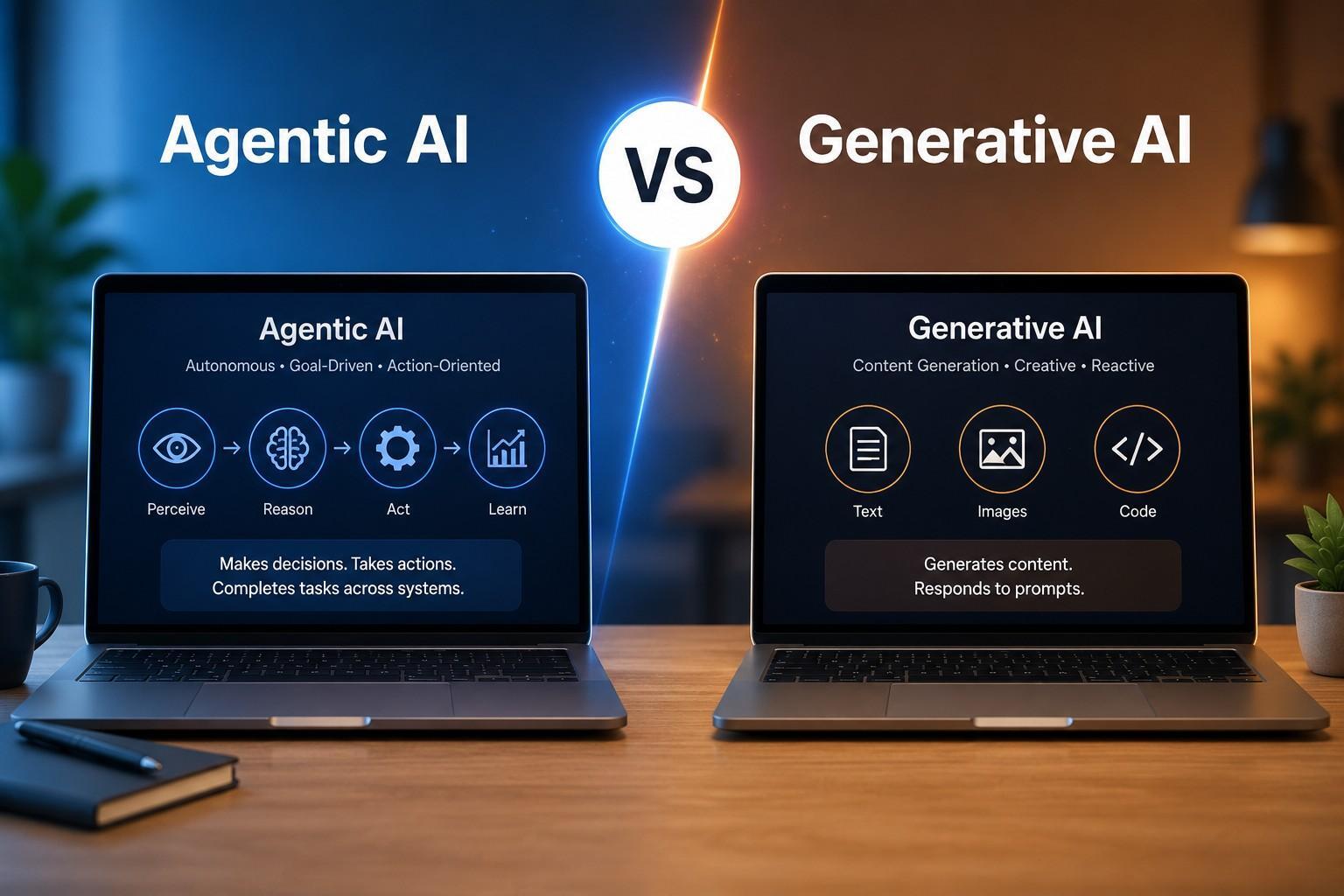
Artificial Intelligence has evolved rapidly over the past years, moving beyond simple automation into technologies capable of analysing information and executing complex processes. Now businesses are faced with an important question: agentic AI vs generative AI, which one delivers more value?
Generative AI is designed to create content such as text, images, software code, and audio in response to user prompts. Agentic AI, on the other hand, moves beyond content generation. Rather than simply responding to prompts, it focuses on planning, reasoning, making decisions, and completing multi-step tasks with minimal human input.
Understanding agentic AI vs generative AI is becoming important because businesses rarely need to choose one over the other. In many real-world scenarios, both technologies complement each other.
At Smart Digitants, we help businesses across the UK identify practical AI opportunities that align with commercial objectives rather than following technology trends.
This guide explores the differences between agentic AI and generative AI, explains how each technology works, examines real applications, and shows how combining both can help organisations unlock smarter automation and long-term competitive advantage.
What Is Generative AI?
Generative AI refers to a branch of Artificial Intelligence that creates original content by learning patterns from vast amounts of existing data. Unlike traditional AI, which is designed to follow predefined rules or perform specific routine tasks, generative AI produces content such as text, images, software code, audio, and videos in response to user prompts. It has become one of the most widely adopted forms of AI technology because it enables businesses to create high-quality outputs quickly while reducing the time spent on repetitive creative work.
At its core, generative AI models learn from large datasets using machine learning techniques. These models rely on statistical pattern recognition to understand language, context, and relationships within training data.
Most modern gen AI models are powered by large language models (LLMs), which are trained on billions of words from books, websites, research papers, and other publicly available sources. These models use natural language processing (NLP) to understand human language, enabling them to answer questions, draft documents, summarise reports, generate software code, and support a wide range of business activities.
Generative AI is often the first technology businesses encounter. Tools such as ChatGPT, Claude, Gemini, and Microsoft Copilot have made AI accessible to organisations of all sizes by simplifying tasks that once required significant manual effort, and they sit alongside a growing ecosystem of AI chatbot apps designed for both consumers and enterprises.
Marketing teams use it to create keyword optimised blog posts and email marketing content while it can also aid in the software development process.
Despite these strengths, generative AI is a reactive content engine. It generates responses only when prompted by users and typically produces single outputs rather than managing an entire workflow. For example, it can draft a customer email or prepare a financial report, but it will not automatically send the email, update the CRM, notify the sales team, or schedule follow-up actions unless another system executes those tasks.
This distinction is one of the key differences in the debate around agentic AI vs generative AI. While generative AI work begins with a prompt and ends with an output, it still depends on human intervention or another AI system to decide what happens next. As a result, businesses often combine generative AI capabilities with workflow automation tools to complete the entire process. That is where agentic AI vs generative AI debate enters the picture.
What Is Agentic AI and AI Agents?

While generative AI focuses on creating content, agentic AI focuses on taking action. It represents the next stage of Artificial Intelligence, where AI systems are designed not only to generate information but also to plan, reason, make decisions, and execute complex tasks with minimal human input. This shift from content generation to autonomous execution is the defining factor in the discussion around agentic AI vs generative AI. Instead of waiting for constant user instructions, agentic AI acts proactively to complete tasks and achieve desired outcomes.
Unlike traditional AI, which typically follows fixed rules, agentic AI operates using reasoning, planning, memory, and continuous learning. It uses a four-step approach: perceive, reason, act, and learn. This cycle allows agentic AI makes decisions that adapt to real-time business conditions rather than relying solely on predefined workflows.
The same principles apply across industries.
- In healthcare, agentic AI monitors patient data continuously.
- Financial institutions use agentic AI for real-time risk management.
- Agentic AI can enhance cybersecurity by responding to threats autonomously.
- In logistics, Agentic AI can optimise supply chain operations automatically.
- In human resources, agentic AI can automate customer service workflows autonomously
Agentic AI architecture helps it manage business processes autonomously while adapting to changing conditions. Rather than following a fixed sequence of instructions, it analyses new information in real time and adjusts its plans accordingly. This ability makes it particularly valuable for complex tasks, multi-step tasks, and complex processes that require coordination across departments or software platforms.
Understanding agentic AI vs generative AI ultimately comes down to understanding their core function. Generative AI produces content, while AI agents focus on execution and problem-solving. This distinction explains why businesses increasingly view both agentic AI vs generative AI as complementary technologies rather than competing solutions.
Agentic AI vs Generative AI at a Glance
The discussion around agentic AI vs generative AI is not about choosing one technology over another. Instead, it is about understanding how each addresses different business challenges. While generative AI focuses on producing content in response to user prompts, agentic AI focuses on executing tasks, making decisions, and managing workflows autonomously. Together, they represent the next stage of business automation.
Difference in Working of Agentic AI VS Generative AI
Generative AI is best understood as a reactive content engine. It generates responses only when prompted by users and typically produces single outputs such as reports, emails, images, software code, or marketing copy.
Because generative AI models learn from existing data using machine learning and natural language processing, they excel at creating SEO-optimised content, brainstorming ideas, and accelerating creative work across departments.
Agentic AI is proactive and goal-driven, using AI agents that perceive information, reason about available options, act on decisions, and continuously learn from outcomes. This perceive, reason, act, and learn cycle enables agentic AI systems to manage complex workflows, complete multi-step tasks, and automate business processes with minimal human oversight. Rather than stopping after generating information, agentic AI acts upon it by interacting with application programming interfaces, databases, external tools, and business software.
Uses of Agentic AI vs Generative AI
For most organisations, the strongest business value comes from combining both agentic AI vs generative AI. Generative AI provides the reasoning, analysis, and content required to support decision making, while agentic AI executes actions across multiple systems and automates workflow management from beginning to end.
Some of the biggest business benefits include:
- Faster content creation through generative AI tools.
- End-to-end workflow automation powered by autonomous AI agents.
- Improved operational efficiency by reducing repetitive tasks and enabling human teams to focus on higher-value work.
Rather than viewing agentic AI vs generative AI as competing technologies, businesses should see them as complementary capabilities that strengthen different stages of the same workflow. Organisations that understand where each technology fits will be better positioned to build scalable AI systems that deliver measurable commercial outcomes.
When You Should Choose Agentic AI vs Generative AI? Business Use Cases
Understanding agentic AI vs generative AI becomes much easier when viewed through practical business applications.
Generative and agentic AI complement each other by combining intelligent content generation with autonomous execution, enabling organisations to streamline operations, improve customer experiences, and make faster, data-driven decisions.
Marketing and Content Creation

Marketing teams were among the first to embrace AI, largely because generative AI excels at producing high-quality content at scale for marketing automation strategy.
Businesses use gen AI tools and other generative tools to write blog articles, landing pages, email campaigns, social media posts, and product descriptions. They also help analyse market trends, identify relevant topics, and personalise messaging for different customer segments.
However, content creation is only one part of a successful marketing strategy. Once content is approved, agentic AI can automate the remaining process by scheduling posts, distributing campaigns across channels, monitoring performance metrics, and triggering follow-up actions based on audience engagement. Instead of relying on separate manual tasks, businesses can create connected AI workflows that handle the entire campaign lifecycle with minimal human intervention.
Sales and Customer Service
Sales and support teams benefit significantly from combining both agentic AI vs generative AI. Virtual assistants powered by generative AI can answer common customer queries, draft personalised responses, and prepare follow-up emails in seconds, drawing on the same core technologies that power modern conversational AI platforms. This improves response times while maintaining consistency across customer interactions.
The role of agentic AI extends much further. It can qualify leads, update CRM records, schedule meetings, assign enquiries to the appropriate sales representatives, and automate customer service workflows autonomously. Because agentic AI works across multiple business applications, it ensures that every stage of the customer journey is completed without constant manual supervision. This enables organisations to provide faster, more consistent service while allowing employees to focus on building stronger customer relationships.
Finance and Risk Management
The financial sector increasingly relies on AI to improve accuracy and respond quickly to changing conditions. Generative models can summarise reports, explain financial performance, and produce executive briefings from complex datasets.
Meanwhile, agentic AI takes a more operational role by monitoring transactions, identifying anomalies, and supporting financial risk management in real time. Rather than simply highlighting potential risks, it can initiate predefined actions, notify relevant stakeholders, and coordinate responses across connected systems. This proactive approach helps organisations reduce exposure to risk while improving operational resilience.
Operations and Workflow Automation
One of the strongest business cases for agentic AI lies in operational efficiency. Organisations often manage complex processes involving multiple departments, software platforms, and approval stages. Coordinating these activities manually can be time-consuming and prone to delays.
Using an agentic AI framework, businesses can automate repetitive operational activities, manage approvals, coordinate tasks between departments, and optimise resource allocation. Agentic systems can execute multi-step workflows with a single model context protocol while adapting to real-time changes.
This reduces administrative overhead and enables employees to concentrate on strategic work rather than routine tasks.
Why Businesses Need Both Technologies
The debate around agentic AI vs generative AI often suggests that organisations should choose one technology over the other. In reality, the key difference lies in the role each plays within a business process.
Generative AI creates valuable outputs such as reports, marketing content, software code, and customer communications. Agentic AI then transforms those outputs into completed actions by managing workflows, coordinating systems, and executing business processes autonomously.
Businesses that integrate both technologies instead of debating about agentic AI vs generative AI, gain the best of both worlds. Generative AI supports creativity, communication, and knowledge generation, while agentic AI delivers execution, automation, and operational efficiency. Together, they create intelligent business ecosystems capable of responding to changing demands with speed and accuracy.
Ready to Transform Your Business with AI?
Adopting AI is no longer about experimenting with the latest technology. It is about implementing solutions that deliver measurable business outcomes.
At Smart Digitants, we help UK businesses identify where AI can create the greatest impact, whether that involves AI strategy, or understanding chatbots and AI agents.
Our team works closely with organisations to design practical AI solutions that align with their goals, integrate seamlessly with existing systems, and deliver long-term value. From selecting the right AI tools to implementing scalable automation strategies, we ensure your AI investment supports sustainable business growth.
Ready to take the next step in your AI journey? Request a tailored quote from Smart Digitants today to discover how the right combination of agentic AI vs generative AI can help your business work smarter, move faster, and stay ahead in an increasingly competitive digital landscape.

Our Content Writing Team at Smart Digitants is a group of dedicated professionals, passionate about creating high-quality, engaging content.


