Artificial intelligence has evolved rapidly over the last few years.
Businesses are no longer satisfied with AI assistants that only answer questions from their training data. They expect AI systems to retrieve live information, connect with business software, automate repetitive tasks, and interact with multiple tools without requiring developers to build separate integrations for every application.
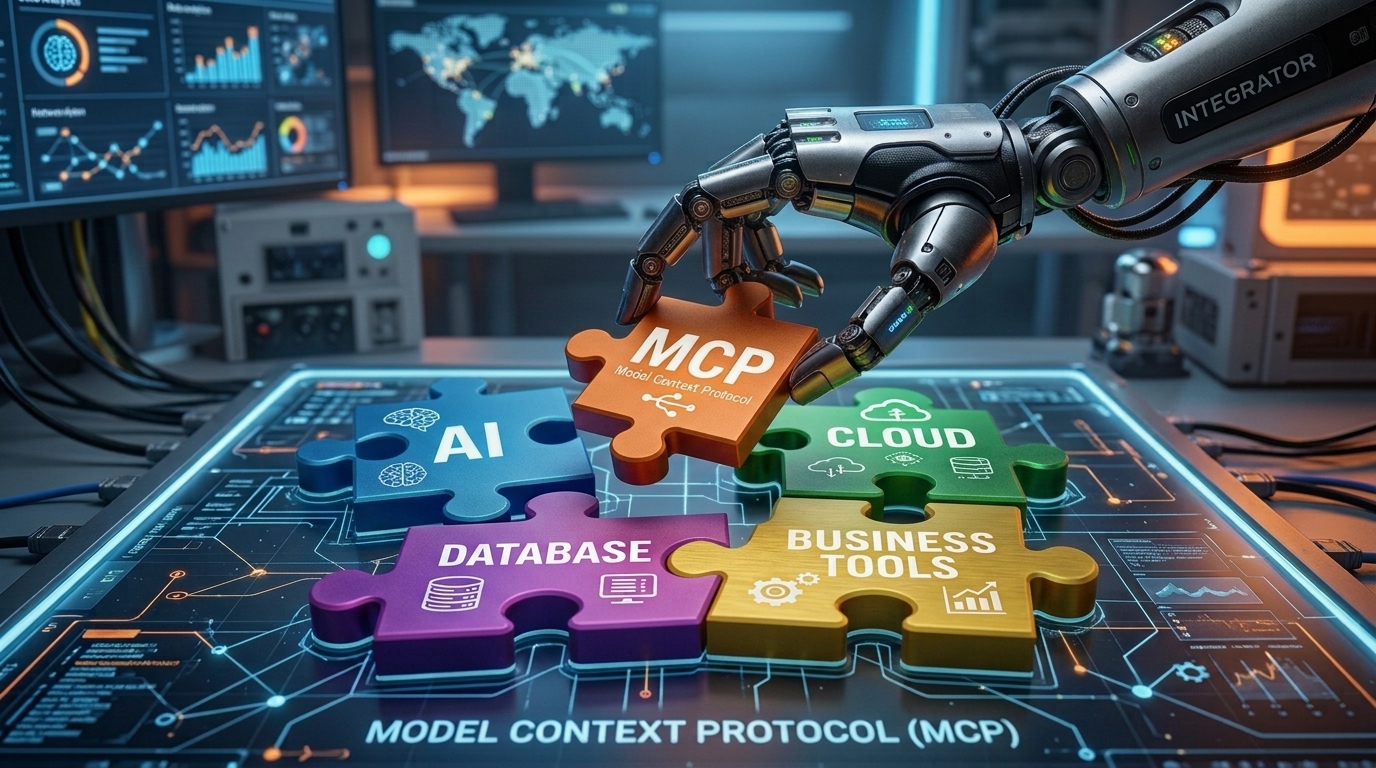
This growing demand has led to the rise of Model Context Protocol (MCP), a new standard that simplifies how AI models communicate with external tools and data sources. Rather than creating dozens of custom integrations, developers can adopt one standardised protocol that works across different AI applications and services.
If you are exploring AI agent system for your business or simply want to understand why developers are discussing Model Context Protocol (MCP), this guide explains everything in straightforward language.
What Is Model Context Protocol?
Model Context Protocol (MCP) is an open-source standard enabling AI connections to data sources and tools. Instead of building a unique integration for every AI model and every external service, developers can use a single, standardised way for connecting AI assistants with external systems.
The protocol was introduced by Anthropic in November 2024. Since then, it has gained significant attention across the AI community because it solves one of the biggest challenges in modern AI integration: giving AI applications reliable access to live information without creating complex, vendor-specific integrations.
Many developers compare MCP Model Context Protocol to a USB C port for AI. Just as a USB C port allows different devices to communicate using one universal connector, MCP provides a universal protocol for AI systems to communicate with connected tools, remote resources and external data sources.
Without this context protocol, developers often need to write custom code every time an AI application connects to a CRM system, cloud service, content repositories, databases or business software. As organisations adopt more AI powered applications, these custom integrations quickly become difficult to manage.
Model Context Protocol changes this by introducing one standardised protocol that different AI models can understand.
Why Was Model Context Protocol (MCP) Created?
Traditional AI applications mainly rely on training data. Although modern large language models are highly capable, they cannot automatically access real time data unless developers build dedicated integrations.
This creates several problems.
Traditional APIs require hardcoded endpoints for each service. Every additional AI model and every new external system increases web development effort. As organisations expand their AI capabilities, maintaining these custom integrations becomes increasingly expensive.
Model Context Protocol (MCP) addresses this challenge by reducing integration complexity from N×M to N+M. Instead of creating individual connections between every AI model and every external service, developers only need to support the protocol itself.
As a result, Model Context Protocol reduces development time by standardising integrations across multiple tools and models. It also enables greater interoperability among different AI models and systems, avoiding vendor-specific integrations and reducing vendor lock.
Perhaps even more importantly, Model Context Protocol (MCP) enhances accuracy by providing access to real-time data, reducing reliance on static training data. This means AI assistants can retrieve relevant information from external data sources instead of relying entirely on what they learned during model training.
For businesses, this leads to more reliable AI responses and helps reduce hallucinations when AI applications perform tasks using live information.
How Does Model Context Protocol (MCP) Work?
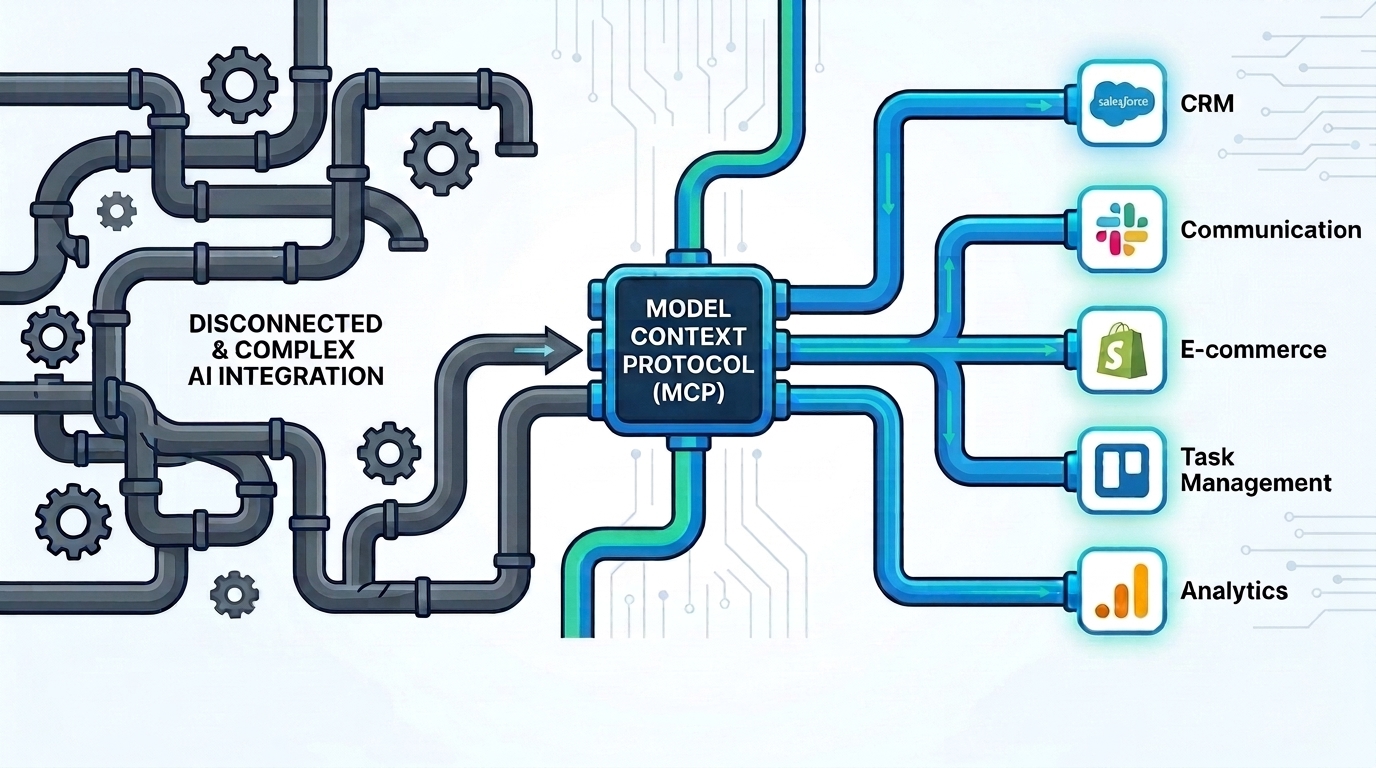
At its core, Model Context Protocol (MCP) follows a client server architecture that standardises communication between AI systems and external tools.
Rather than every AI application creating its own integration, MCP defines a common communication layer that allows different components to work together. The MCP architecture includes MCP servers, clients, and hosts.
Each component has a specific responsibility.
| Component | Primary Responsibility |
| MCP Host | Coordinates AI applications and available server capabilities |
| MCP Client | Translates user intents into protocol messages |
| MCP Server | Exposes data and tools via standardised interfaces |
The MCP host is usually the AI powered application, such as Claude Code, an AI powered IDE or another assistant. The host manages conversations, coordinates connected tools and determines when external resources should be accessed.
The MCP client sits between the host and available services. MCP clients translate user intents into protocol messages and manage communication with one or more MCP servers. They also handle tool discovery, maintain active connections and process responses returned by servers.
An MCP server performs the actual connection to external systems. MCP servers expose data and tools via standardised interfaces, making them available in a machine readable format that AI models can understand.
Unlike traditional APIs that depend on fixed endpoints, Model Context Protocol (MCP) allows dynamic discovery of tools at runtime. This means AI agents can dynamically discover callable tools without requiring developers to manually configure every connection beforehand.
This flexible approach is one of the reasons why the MCP ecosystem is expanding so quickly across the UK AI integration projects.
MCP Architecture: Understanding How Everything Connects
Although Model Context Protocol (MCP) is often described as a communication standard, its real strength lies in its architecture. The protocol has been designed to make AI integration simpler, more scalable and easier to maintain as organisations introduce additional AI models, external services and automated workflows.
Rather than tightly coupling an AI application with every external system, MCP Model Context Protocol separates responsibilities between hosts, clients and servers. This client server model creates a cleaner AI agent architecture where each component performs a specific role while communicating through a shared protocol.
As organisations expand their AI capabilities, they can add new tools or replace existing ones without changing the application’s core logic. Model Context Protocol (MCP) improves scalability by allowing additional servers to be deployed without changing application logic, making it particularly suitable for businesses adopting multiple AI-powered solutions.
The Role of the MCP Host
The MCP host is the AI application that users interact with. This could be an AI assistant, an AI powered IDE, Claude Code or an internal business application that uses large language models to complete tasks.
The host is responsible for coordinating conversations and determining when external information is needed. Instead of directly connecting to every cloud platform, database or CRM system, it delegates these requests through the protocol.
Importantly, MCP hosts coordinate MCP clients and server capabilities. This orchestration layer allows AI applications to combine information from multiple tools without developers building separate integrations for every workflow.
For example, if a sales manager asks an AI assistant to generate a customer report, the host may coordinate requests to:
- A CRM system
- Internal content repositories
- A cloud service storing sales data
- A reporting platform
- External data sources for market information
The user experiences one seamless interaction, while the host quietly manages multiple connected tools behind the scenes.
How the MCP Client Works
The MCP client acts as the communication bridge between the host and available servers.
Its responsibilities go far beyond simply forwarding requests. MCP clients translate user intents into protocol messages, discover available tools, maintain active connections and return structured responses to the host to maintain a complete AI automation system.
One of the biggest advantages of Model Context Protocol (MCP) is dynamic tool discovery. Rather than hardcoding every available integration, the client can dynamically discover newly available tools during runtime. This means organisations can introduce new MCP server implementations without rewriting their AI applications.
For example, if a business adds a document management platform next month, the AI assistant can immediately recognise the newly available callable tools once the appropriate server is connected. This dramatically reduces maintenance compared with traditional API integrations.
What MCP Servers Do
While the client manages communication, MCP servers provide access to external systems. MCP servers expose data and tools via standardised interfaces. Each server advertises its available capabilities through tool descriptions and structured metadata.
These descriptions are presented in a machine readable format, allowing AI models to understand:
- Available callable tools
- Required inputs
- Expected outputs
- Permission requirements
- Resource locations
Because everything follows the same standardised protocol, AI applications no longer need custom code for every external service.
An organisation may deploy separate MCP servers for:
- CRM platforms
- Document libraries
- Internal databases
- Financial systems
- Customer support platforms
- Cloud storage
- Development environments
Instead of learning dozens of proprietary interfaces, the AI only needs to understand Model Context Protocol (MCP).
JSON-RPC 2.0: The Communication Layer
Communication between clients and servers needs to be reliable, predictable and efficient.
For this reason, MCP requires implementing JSON-RPC 2.0 messaging for communication.
Similarly, MCP uses JSON-RPC 2.0 for client-server communication, providing a lightweight and consistent transport layer for structured calls between different components.
Rather than sending unstructured text, requests are packaged into clearly defined messages that include:
- The requested tool
- Input parameters
- Request identifiers
- Structured responses
- Error handling information
This makes communication easier to validate and significantly reduces implementation details that previously varied between different APIs.
Unlike traditional APIs, MCP supports bidirectional, stateful communication unlike traditional APIs. This enables ongoing conversations where both the client and server maintain context throughout a session.
As a result, AI agents can execute complex workflows involving multiple tools without repeatedly creating new connections.
Local vs Remote MCP Servers
One of the strengths of Model Context Protocol (MCP) is deployment flexibility.
MCP servers can be deployed locally or remotely based on requirements.
The choice depends on security requirements, performance expectations and the nature of the connected resources.
| Local MCP Servers | Remote MCP Servers |
| Run on the same machine | Hosted on external infrastructure |
| Ideal for local resources | Better for cloud platforms and remote resources |
| Lower latency | Easier organisational sharing |
| Strong data privacy | Greater scalability |
| Useful for development | Suitable for distributed teams |
Many organisations use hybrid environments where local MCP servers handle sensitive business information while remote servers connect to cloud services and external systems. This allows businesses to balance performance, scalability and security without sacrificing flexibility.
Model Context Protocol (MCP) Versus RAG
Many people assume Model Context Protocol (MCP) replaces Retrieval-Augmented Generation (RAG), but the two technologies solve different problems. RAG focuses on retrieving relevant information from indexed documents before generating an answer.
Model Context Protocol, however, standardises how AI systems connect to external tools. This means MCP can do much more than retrieve documents. It allows AI agents to:
- Access real time data
- Update business records
- Trigger automated workflows
- Query databases
- Interact with external services
- Perform tasks across multiple tools
In many modern AI systems, MCP versus RAG is not an either-or decision. They often complement one another. RAG retrieves relevant information from knowledge bases, while Model Context Protocol (MCP) provides live access to external tools and data sources.
Real-World Applications of Model Context Protocol (MCP)

The popularity of Model Context Protocol MCP continues to grow because it solves practical business problems rather than theoretical ones. Businesses are already using the protocol to build smarter AI applications capable of interacting with diverse systems in real time.
Some common use cases include:
- AI assistants retrieving customer records from a CRM system before drafting emails.
- AI agents accessing financial dashboards to generate live reports.
- Development teams connecting Claude Code and AI powered IDE platforms with repositories, testing tools and deployment environments.
- Customer support assistants retrieving live order information instead of relying on outdated training data, building on chatbot integration across CRM and support systems.
- Marketing teams using connected tools to automate campaign creation across several cloud platforms.
- Internal knowledge assistants searching content repositories while simultaneously retrieving live business metrics from external data sources.
Because Model Context Protocol (MCP) enables AI models to access real-time data and allows AI agents to perform tasks using live data, organisations can build more accurate, responsive and useful AI-powered agents and workflows than was previously possible.
Security Best Practices for Model Context Protocol (MCP)
As organisations adopt Model Context Protocol (MCP) for business-critical AI applications and complex multi-agent AI systems, security must remain a priority. Since AI systems interact with external tools and sensitive data sources, strong security controls are essential.
Organisations must enforce Transport Layer Security (TLS) for MCP implementations, and MCP requires Transport Layer Security (TLS) for remote transports to protect data exchanged between clients and servers.
Other recommended practices include:
- MCP servers must implement strict tool permissions to prevent unauthorised access.
- Audit logging is essential for tracking actions performed by MCP servers.
- MCP implementations should enforce rate limiting to prevent abuse.
- Sandboxing local MCP servers where appropriate.
- Requiring human approval before executing high-risk actions.
- Regularly updating server implementations to address emerging security vulnerabilities.
Developers should also be aware that prompt injection can lead to unintended actions by MCP servers. Validating user input, limiting permissions and reviewing tool access help reduce potential security threats.
Our guide to AI Agent Security explores the key risks and practical measures for securing these systems in detail.
Benefits and Limitations of Model Context Protocol (MCP)
The growing adoption of MCP reflects the practical advantages it offers for AI integration.
Benefits
- MCP standardises connections to external tools and data sources.
- MCP enables AI models to access real-time data.
- MCP enables real-time data access for AI applications.
- MCP allows AI agents to perform tasks using live data.
- MCP enhances agent capabilities for executing complex workflows within AI applications.
- MCP enhances accuracy by providing access to real-time data, reducing reliance on static training data.
- MCP reduces integrations from N×M to N+M, simplifying development and maintenance.
- MCP improves scalability by allowing additional servers to be deployed without changing application logic.
- MCP enables greater interoperability among different AI models and systems, avoiding vendor-specific integrations.
Limitations
While Model Context Protocol (MCP) offers significant advantages, successful adoption still requires planning. Organisations need suitable infrastructure, skilled implementation and effective governance.
For reliable performance, MCP implementations need adequate GPU/CPU capacity and low-latency networks. As the ecosystem continues to evolve, businesses should also monitor compatibility, implementation details and future protocol updates.
Build Effective AI Solutions with Smart Digitants
By reducing integration complexity, supporting dynamic tool discovery and improving interoperability across AI systems, MCP is shaping the future of AI integration. While successful implementation requires careful attention to security, infrastructure and governance, the long-term benefits make it a compelling choice for businesses building intelligent, connected applications.
At Smart Digitants, we help UK businesses turn AI ideas into practical solutions. Whether you are beginning your AI journey or expanding existing AI systems, our team can design and implement secure, scalable Model Context Protocol (MCP) solutions tailored to your needs.
Our services include:
- AI integration strategy and consulting
- Custom MCP server implementations
- AI workflow automation
- Integration with CRM systems, cloud platforms and external services as part of
- Planning marketing automation for your business
- Custom connectors for business applications
- AI documentation, training and ongoing technical support
By combining technical expertise with business insight, we help organisations build AI-powered applications that are reliable, secure and ready for future growth.
Frequently Asked Questions
What is Model Context Protocol MCP?
MCP is an open-source standard that enables AI models to securely connect with external tools and data sources using a standardised protocol.
Who introduced MCP?
MCP was introduced by Anthropic in November 2024 to simplify AI integration across multiple tools and systems.
Does Model Context Protocol (MCP) replace APIs?
No. MCP complements existing APIs by providing a standardised communication layer. It reduces the need for custom integrations but still relies on underlying services and APIs.
Can MCP improve AI accuracy?
Yes. By enabling AI models to access live information instead of relying solely on training data, Model Context Protocol helps reduce hallucinations and improves the relevance of AI responses.
Is Model Context Protocol (MCP) suitable for small businesses?
Yes. Businesses of all sizes can benefit from MCP, particularly when connecting AI assistants with multiple business tools, databases and cloud services.

Our Content Writing Team at Smart Digitants is a group of dedicated professionals, passionate about creating high-quality, engaging content.