

Your website is not a museum. Every blog post, service page, and landing page should earn its place by driving traffic, generating leads, or converting visitors into paying customers.
A content audit is a systematic review and analysis of all digital content on a website, evaluating quality, relevance, and performance to decide whether each page should be kept, updated, consolidated, or removed. Content audits improve website traffic and user experience when executed properly.
Our step-by-step framework connects SEO mechanics to commercial outcomes like leads, sales, and cost per acquisition, going well beyond vanity metrics such as page views or keyword counts.
We at Smart Digitants approach every content audit as part of a long-term digital marketing growth measure, not a one-off report. Our clients have seen results including 200% revenue increases and 10x sales uplifts on the same spend through systematic optimisation.
You will leave this guide with a practical content audit process, a simple content audit template structure, and a checklist of recommended content audit tools you can start using today.
What Is a Content Audit? & Why do you Need it?
A content audit analyses existing website content performance across every published URL, including blog posts, service pages, product pages, category pages, downloadable guides, and key landing pages.
There are several types to be aware of.
- A website content audit covers SEO, UX, design, and conversion paths across your entire website.
- An SEO focused content audit focuses specifically on how content performs in organic search, covering rankings, traffic, keywords, and crawlability.
- A broader digital content audit extends to assets in email, social media posts, and knowledge bases beyond the main domain.
A typical content audit process includes inventorying content, gathering performance data, and evaluating quality. The output is a clear decision for every URL: keep it, update it, consolidate it with similar pages, or remove it.
A content marketing audit should always connect back to commercial goals like leads, sales, and pipeline value. Rankings and traffic volumes matter, but only when they translate into business outcomes.
How Content Audits Power a Stronger Content Strategy
Without a content audit, most businesses end up with a scattered collection of web pages that were created at different times, for different reasons, by different people. An audit transforms that collection into a coherent content strategy tied to real buyer journeys.
The insights from a comprehensive content audit feed directly into quarterly content roadmaps. Instead of publishing random new posts, you prioritise high-impact updates on existing materials that already have traction. Content audits improve search engine visibility and rankings when the findings are acted upon consistently.
At Smart Digitants, we use audit findings to align content work with digital transformation strategy, ensuring that every page supports measurable business goals.
Step-by-Step Framework for a Successful Content Audit
Let’s understand how to perform a content audit and use its outcomes for your digital marketing goals.
Step 1: Define Clear Goals for Your Content Audit Project
Establishing clear goals is essential before starting a content audit. Without them, you will collect a mountain of content audit data with no idea what to do with it.
Common goals for a content audit project include:
- Recovering lost traffic after a 2024 or 2025 Google core update that hit your key pages.
- Improving conversion rates on service or product pages that get visits but generate few enquiries.
- Cleaning up outdated content from the COVID era or pre-Brexit guidance that no longer applies.
- Eliminating cannibalisation where multiple pages compete for the same search queries.
- Preparing for a website redesign by identifying which existing content is worth migrating and which should be retired.
- Reducing wasted content spend by stopping investment in topics that never perform.
Capture these goals explicitly at the top of your content audit template so the team audits against business outcomes at every stage.
Step 2: Decide the Scope of Your Website Content Audit
UK SMEs rarely need to audit every URL at once. Scoping the audit avoids overwhelm and helps you hit realistic deadlines.
Here are practical scope patterns:
- Full site content audit for sites with fewer than 1,000 URLs. Manageable in one pass.
- Product and category pages first for e-commerce businesses where revenue pages matter most.
- Blog post library first for content-heavy B2B sites where organic traffic drives top-of-funnel awareness.
- Lead-generation landing pages first for service businesses where a handful of pages drive the majority of enquiries.
A site audit can extend beyond the primary domain to subdomains like /blog/, /resources/, or a knowledge base if those sections generate significant organic traffic. Start with the 20 to 30 percent of website pages that drive 70 to 80 percent of organic traffic or revenue. Use analytics data to identify them before you touch anything else.
Step 3: Build a Robust Content Inventory

The audit process begins with a complete content inventory. The goal here is simple: get every published URL into a single spreadsheet.
- Crawl your site using a tool like Screaming Frog, which audits up to 500 URLs for free. For larger sites, the paid version covers unlimited URLs.
- Cross-reference with your XML sitemap to catch pages the crawler might miss, and export your full URL list from Google Search Console (no-follow) for an additional data layer.
- Merge everything into one sheet. Google Sheets works well for collaboration across teams.
Essential columns for your content inventory spreadsheet:
| Column | What It Captures |
| URL | Full page address |
| Page type | Blog, service page, product page, category, landing page |
| Main topic | What the page is about |
| Primary keyword | The target search term |
| Publish date | When it was first created |
| Last updated | Most recent edit |
| Status | Live, redirected, 404 |
The content inventory tells you what exists. The content audit tells you how it performs and what to do with it. These are distinct steps, and skipping the inventory means you will miss pages that quietly drain crawl budget or create duplicate content issues.
Step 4: Collect Performance and SEO Data for Each URL
This phase turns a basic inventory into an actionable SEO content audit. You need hard numbers beside every URL. Key metrics to capture per URL:
- Organic sessions for the last 12 months
- Average position for primary keywords
- Number of ranking keywords
- Conversion events (form fills, calls, purchases)
- Bounce rate and engagement time
- Backlink count and quality
Content performance metrics include organic traffic, bounce rate, and conversions, and all three should appear in your audit spreadsheet. Content audits analyse SEO performance and conversions side by side so you can see which pages rank well but fail to convert, and which convert brilliantly but get almost no search visibility.
Step 5: Evaluate Content Quality and Relevance
Numbers only tell half the story. Conducting a content audit means combining quantitative data with qualitative review to evaluate content performance properly.
During manual checks, look for:
- Outdated statistics, legislation references, or pricing that no longer applies. Content audits identify outdated, duplicate, or underperforming content that damages credibility.
- Thin word count on important topics where competitors publish far more comprehensive guides.
- Confusing content structure: missing headings, no clear hierarchy, walls of text.
- Weak or absent calls to action on key service pages.
- Poor content quality signals: no author byline, no credentials, no references to real experience.
Score each page on a simple 1 to 5 quality scale covering accuracy, E-E-A-T signals, and alignment with current brand positioning. This makes prioritisation far easier in later steps.
Step 6: Run a Structured Content Gap Analysis
Content gap analysis compares what you have published against what your target audience actually searches for. Content gaps can be identified through a content audit to inform future content strategy, particularly in crowded UK sectors like finance, legal, and home services.
Here is how to run this analysis for search engine rankings:
- Export a list of topics and keywords your competitors rank for using tools like Ahrefs Content Gap or Semrush.
- Compare those topics against your own content audit spreadsheet to find missing buying-stage pages, FAQs, and comparison posts.
- Prioritise gaps based on search volume, commercial intent, and relevance to your services.
Identified gaps should become a dedicated tab in your audit spreadsheet, feeding directly into the future content calendar. Identifying content gaps is just as important as fixing existing content, because it reveals where competitors are winning organic search traffic you should own.
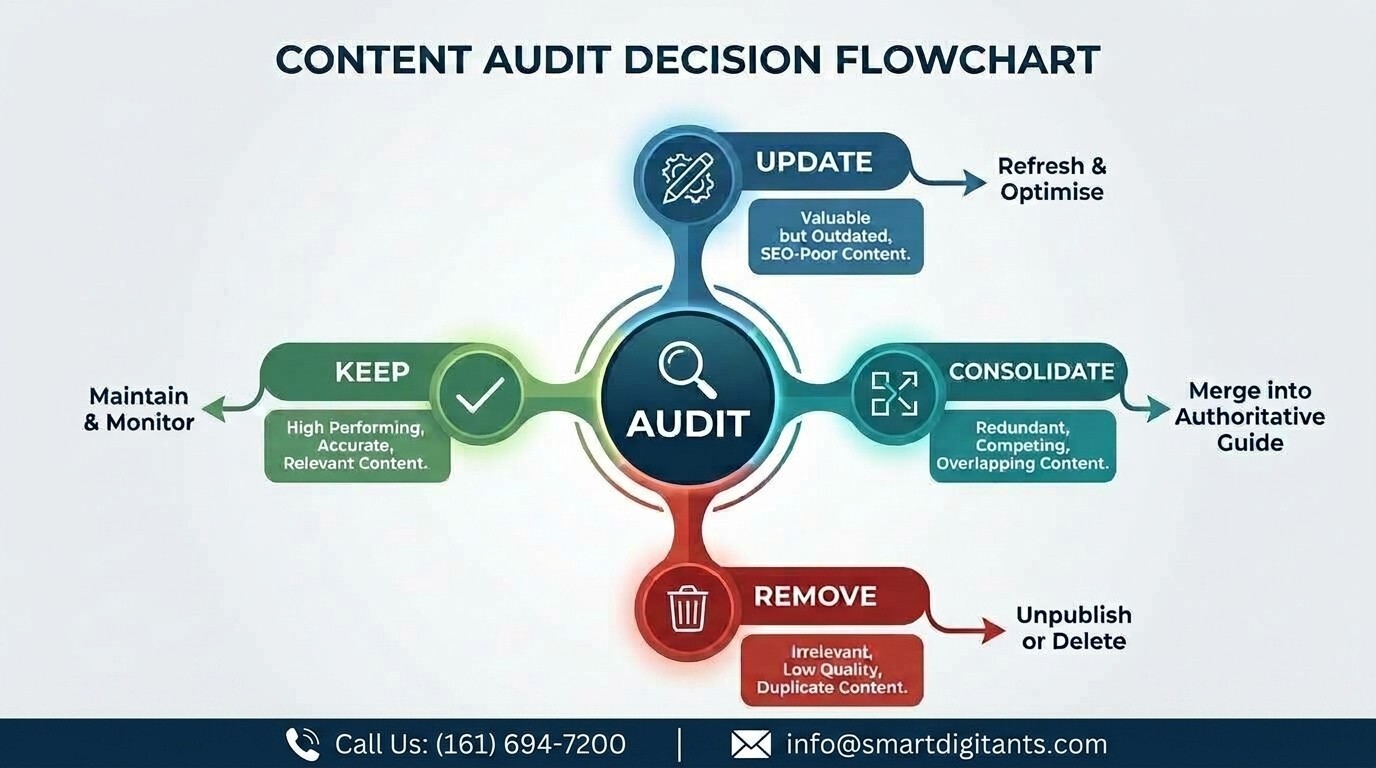
Step 7: Decide Actions: Keep, Update, Consolidate, or Remove
An effective content audit leads to decisions on whether to keep, update, or remove content for every URL in the inventory.
| Action | When to Apply | Example |
| Keep | Strong performance, up-to-date, well-aligned with business goals | A service page ranking in the top 3 with a healthy conversion rate |
| Update | Decent traffic but outdated info, weak on page SEO, or under-optimised calls to action | A 2022 blog post on “UK tax deadlines” still getting visits but referencing old dates |
| Consolidate | Similar topics spread across multiple pages causing keyword cannibalisation | Three short 2019 posts on “Google Ads tips” merged into one comprehensive 2026 guide |
| Remove/Redirect | Zero traffic, duplicate content, obsolete, or reputational risk | A COVID-era temporary notice page that no longer serves any purpose |
Update pages older than six months to improve performance, especially in sectors where regulations, pricing, or product ranges change frequently.
Step 8: Check Technical SEO Issues Affecting Content Performance
Even high quality content fails if a search engine cannot crawl or index it correctly. A content audit can reveal broken links and technical issues that silently undermine your rankings.
Run these specific checks:
- Indexability: Are important pages blocked by accidental noindex tags or robots.txt rules?
- Status codes: Are there 404 errors, soft 404s, or excessive redirect chains?
- Canonical tags: Are canonical URLs pointing where they should, or are they misdirecting crawlers?
- Mobile usability: Do key pages render correctly on mobile devices?
- Internal linking coverage: Are there orphan pages with no relevant internal links pointing to them? Are there broken internal links sending users and crawlers to dead ends?
- Page speed: Do critical landing pages load within acceptable thresholds?
Content audits enhance user experience by fixing broken links and resolving crawl issues that frustrate both visitors and search engines.
Step 9: Build a Simple, Actionable Content Audit Template
A good content audit template needs to be clear, scannable, and tied to outcomes. Minimum recommended columns for your website audit template:
| Column | Purpose |
| URL | Page address |
| Page title | Current title tag |
| Type | Blog, service, product, landing page |
| Primary keyword | Target search term |
| Traffic band | High / Medium / Low |
| Conversion band | High / Medium / Low |
| Quality score | 1 to 5 rating |
| Backlinks band | High / Medium / Low |
| Action | Keep / Update / Consolidate / Remove |
| Owner | Named person responsible |
| Deadline | Target completion date |
Use colour coding so that “Update” and “Consolidate” rows stand out during status meetings.
At Smart Digitants, we use content audit templates inside marketing dashboards, tying page-level changes directly to revenue and lead metrics. This means every stakeholder can see the commercial impact of content decisions, not just the SEO impact.
Step 10: Execute Content Improvements in Priority Order
Audit insights are wasted if they do not lead to systematic implementation over the next three to six months. Typical update actions include:
- Rewriting introductions for clarity and engagement
- Adding UK-specific examples and current statistics (2025 or 2026 data)
- Improving headings and content structure for readability
- Strengthening internal and external links to related resources
- Updating meta description tags and page titles for better click-through rates
- Adding stronger calls to action on other pages that currently lack them
Assign each page to a named owner (writer, SEO specialist, developer) with clear deadlines. Track progress via a simple status column in your audit spreadsheet: Not Started, In Progress, Complete, Live. Measure results two months after implementing changes.
Essential Content Audit Tools for UK Businesses
Content and site audit tools automate data collection for efficiency, but choosing the right stack depends on your budget and site size.
Crawling and indexability tools:
- Screaming Frog: granular technical crawling, free for sites up to 500 URLs, paid for larger sites.
- Google Search Console: free indexing data, query performance, and coverage reports.
Analytics and search data tools:
- Google Analytics 4: free visitor behaviour insights, conversion tracking, organic traffic segmentation.
- Google Search Console (again, indispensable): impressions, clicks, average position per page.
Backlink and authority tools:
- Ahrefs: pricing starts at $129 per month for SEO tools, excellent for backlink analysis and content gap features.
- SEMrush: offers a free trial, then starts at $139.95 per month. Strong for competitive benchmarking and on page SEO audits.
Visual behaviour tools:
- Heatmap tools like Hotjar: understand how users interact with content created on key pages, analyse scroll depth, and identify where visitors drop off.
For smaller UK SMEs, free or low-cost stacks (Google Search Console, Google Analytics 4, Screaming Frog free tier) are enough to start a meaningful website content audit. You do not need to spend thousands on online tools before you have even begun.
Using AI to Accelerate the Content Audit Process
Here is how to use AI safely in your own content audit:
- Upload a trimmed version of your audit spreadsheet (URLs, titles, traffic, quality scores) into an AI assistant and ask it to flag low-traffic pages, cluster URLs into topic groups, or identify duplicated topics across your blog posts.
- Use prompts like “Group these URLs by topic and highlight any pairs that target the same search intent” to accelerate the cannibalisation check.
- Ask AI to draft first-pass rewrite outlines for outdated guides, ready for expert review and UK-specific accuracy checks.
Smart Digitants develops AI agents that can help with ongoing content governance, keeping your site content fresh between major audits.
How Often Should You Run a Content Audit?
Content audits should be conducted quarterly for best results, but the depth of each review can vary.
- Quarterly mini-audits: Focus on your most critical sections, such as top-revenue service pages, high-traffic blog posts, and any content affected by recent algorithm changes or legislative updates.
- Annual deep audit: Cover the entire website, reassess your content strategy, and refresh the full content audit spreadsheet.
- Micro sites (under 50 pages): A thorough annual audit is usually sufficient.
- Content-heavy publishers or regulated organisations: Quarterly reviews on high-risk content are essential to maintain accuracy and trust.
Content audits should also be triggered after major events: Google core updates, new product launches, mergers or acquisitions, legislation changes, or a website redesign. Block time in your annual marketing calendar so that audits become a recurring, expected part of the content strategy process.
Regular audits can enhance search engine visibility and governance by keeping your content library lean and authoritative.
Typical Use Cases: When a Content Audit Delivers Maximum Value
Not every situation calls for the same depth of audit. Here are common scenarios where a focused content audit delivers the highest return:
- Plateaued organic traffic since 2023 or 2024. If your analytics data shows a flat or declining trend despite steady publishing, underperforming content and cannibalisation are likely culprits.
- Hundreds of legacy blog posts with very few conversions. Content created years ago may generate impressions but fail to move visitors toward enquiry or purchase. A content audit pinpoints which pages rank well but need stronger commercial intent.
- Owners unhappy with vague agency reporting. If your current agency talks about “brand awareness” but cannot show you which specific web pages drive leads, a content audit cuts through the noise with actionable insights.
- E-commerce sites with duplicate category pages. Colour and size variations often create duplicate content issues that confuse search engines and waste crawl budget. Consolidation dramatically improves crawl efficiency and sales per visit.
- Pre-ad-spend preparation. Before increasing paid media budgets, conduct content audits to ensure paid campaigns send traffic to the strongest, most conversion-ready pages on your site.
Working with Smart Digitants as Your Digital Growth Partner
Smart Digitants runs content audits as part of wider strategic marketing and digital transformation engagements. We do not produce isolated, one-off reports that gather dust in someone’s inbox. We partner with businesses for the long term, with some client relationships exceeding three years.
We combine technical SEO analysis, content marketing expertise, and web development capability to implement recommendations end to end, so nothing falls through the cracks between strategy and execution.
Ready to stop guessing and start growing? Book a consultation to discuss your own website content audit. We will review your current content, identify the biggest opportunities, and build a plan that ties directly to leads and revenue.
FAQs
How long does a content audit take for a typical UK small business website?
A focused content audit for a site with 100 to 300 URLs usually takes two to four weeks from inventory to final action plan. The timeline depends on how quickly analytics access is granted, how many stakeholders need to review decisions, and whether any compliance checks are required. Smaller sites with fewer than 50 pages can often be audited in under two weeks.
Is a content audit only about blog posts, or should we include service and product pages?
A thorough website content audit should always include service pages, product pages, and key landing pages. These URLs usually drive the majority of leads and revenue. Blog posts support discovery and education, but ignoring commercial pages means you miss the content that directly affects your bottom line. Content audits focus on every page type that a visitor or search engine can access.
Can I run a simple content audit myself without specialist tools?
Yes. You can run a basic audit using Google Search Console, Google Analytics 4, and a manual spreadsheet in Google Sheets, focusing on your top-traffic pages first. This approach works well for initial triage. However, a specialist agency can check technical SEO, content quality scoring, competitive gap analysis, and commercial prioritisation more effectively.
How often should we refresh our content after the first audit?
Revisit priority pages at least every six to twelve months to update facts, pricing, legislation references, and internal links. Sectors where rules or products change frequently, may need faster refresh cycles. Regular audits boost organic traffic by identifying optimisation opportunities before competitors capitalise on them.
What is the difference between a website audit template and a content audit template?
A website audit template covers technical, design, and UX issues across the whole site, including page speed, mobile responsiveness, security, and accessibility. A content audit template includes creating a content inventory of URLs, measuring SEO performance and commercial outcomes.

Our Content Writing Team at Smart Digitants is a group of dedicated professionals, passionate about creating high-quality, engaging content.