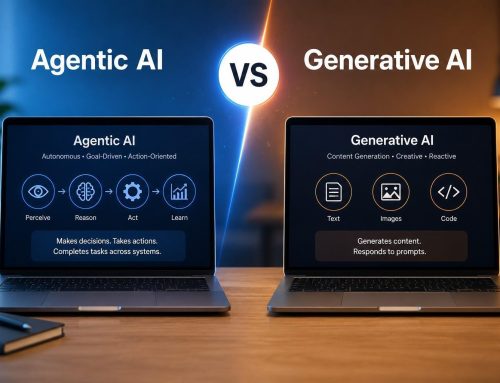
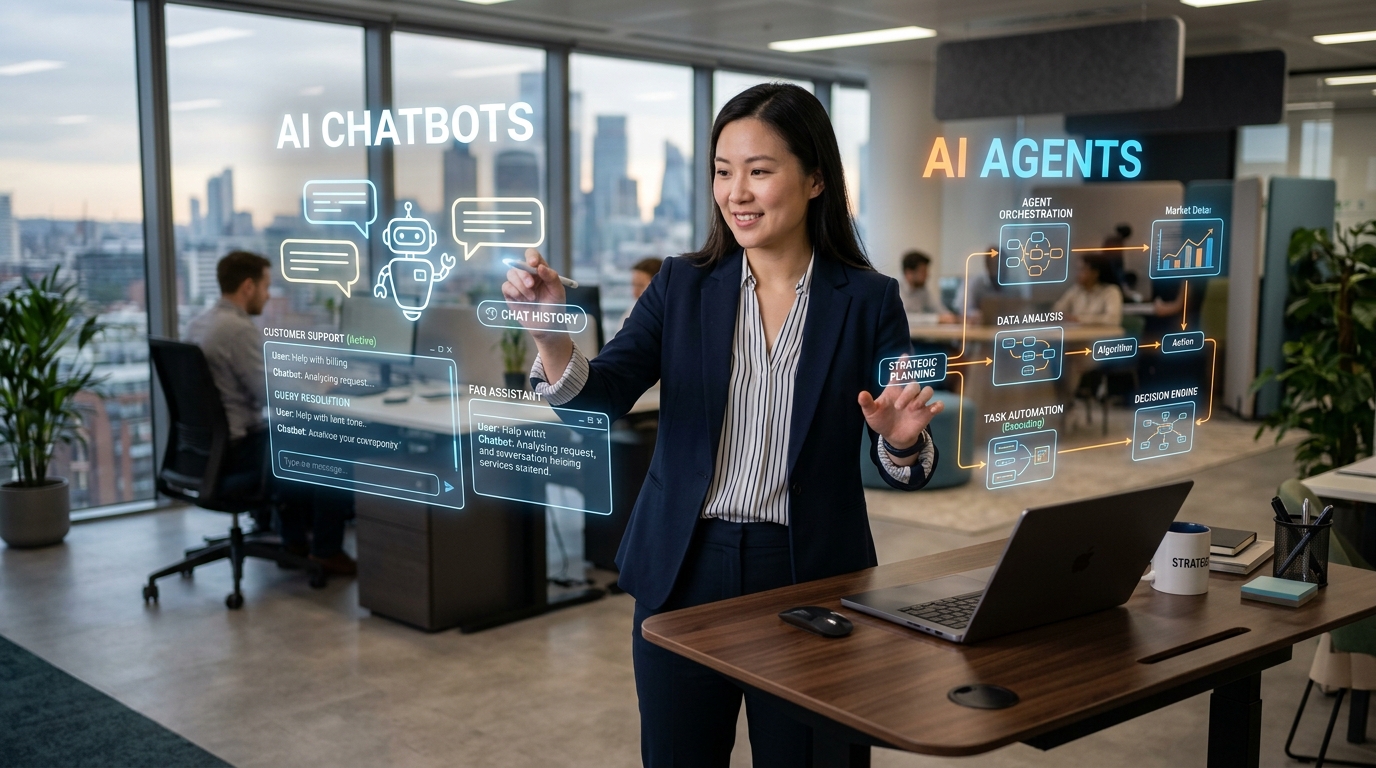
Artificial intelligence has moved well beyond simple customer support tools. As adoption grows, one question appears among business owners and decision-makers: AI agent vs chatbot. While both technologies use artificial intelligence to interact with users, they are designed for different outcomes.
Understanding the AI agent vs chatbot debate is essential before investing in any AI solution. Choosing the wrong technology can lead to unnecessary costs, disappointed customers, and missed automation opportunities.
A chatbot may be ideal for answering straightforward customer queries, while an AI agent can automate complete business processes across multiple systems with little or no human intervention. The right choice depends on your objectives, budget, and the complexity of the work you want AI to perform.
At Smart Digitants, we help businesses adopt practical AI solutions that solve real operational challenges rather than simply adding another piece of technology. Whether you need an intelligent AI chatbot for customer interactions, an advanced AI agent for workflow automation, or a combination of both, understanding their capabilities is the first step towards making an informed investment.
AI Agent vs Chatbot for Business Outcomes
Before exploring the details, this table summarises the most important differences in the AI agent vs chatbot comparison.
| Feature | AI Chatbot | AI Agent |
| Primary purpose | Answer questions and guide users | Complete tasks and automate workflows |
| Decision making | Limited by predefined rules | Autonomous decision making |
| Learning ability | Limited | Improves through continuous learning |
| Context awareness | Basic | Advanced contextual understanding |
| Memory | Often session-based | Long-term memory and context |
| Integrations | Limited | Connects with multiple business systems |
| Best for | FAQs, support, lead capture | Complex workflows and automation |
| Human involvement | Frequently required | Reduced human intervention |
| Complexity | Low to medium | Medium to high |
| ROI | Faster for simple tasks | Greater long-term operational value |
For most growing businesses, the winner in the AI agent vs chatbot comparison is the AI agent because it delivers broader automation and measurable operational improvements.
However, chatbots remain a cost effective solution for simple customer interactions, especially when businesses need to answer questions quickly without investing in more advanced capabilities.
What Is a Chatbot?
An AI chatbot is software designed to simulate conversation with human users by processing natural language and responding to user inputs through text or voice interactions.
Traditional chatbots have been around for years. Early versions relied almost entirely on pre defined rules, decision trees, and pattern matching. Today’s AI powered chatbots are far more capable because they use natural language processing, machine learning models, and increasingly large language models to understand customer intent more accurately.
Even so, the core purpose of an AI chatbot remains the same. It is designed for conversation rather than independent action.

When Your Business Would Need an AI Chatbot?
Typical strengths of AI chatbots include:
- Answering customer queries instantly
- Providing basic information around products or services
- Guiding users through predefined tasks
- Collecting leads and contact details
- Supporting customer interactions outside business hours
- Reducing pressure on human agents
Many organisations deploy AI chatbots across websites, live chat platforms, mobile applications, WhatsApp, Microsoft Teams, Slack, and social media messaging channels. These chatbot apps can provide 24/7 support while maintaining consistent answers based on up-to-date company data.
Modern conversational AI has undoubtedly improved customer experiences, but there are still important limitations. Chatbots follow scripts and respond to user prompts. Chatbots are limited to scripted responses and predefined tasks. They perform limited tasks and typically generate text responses rather than completing actions independently.
For example, imagine a customer asks:“Can I change my delivery date?”
A chatbot may explain the company’s delivery policy and provide a link to the booking page. However, it often cannot log into internal systems, change the booking, notify the warehouse, and email the customer automatically. That distinction lies at the heart of the AI agent vs chatbot discussion.
Memory Limitations
Chatbots often forget previous user interactions due to low context awareness. Although generative AI has improved conversational ability, many AI powered chatbots still struggle to maintain context over extended conversations or across different customer sessions.
As a result, chatbots are best for quick, predictable, and simple interactions where accuracy, speed, and consistency matter more than autonomous problem solving. Chatbots are most effective in situations requiring low-risk interactions.
What Is an AI Agent?
An AI agent is an autonomous AI system that can understand objectives, reason through problems, make decisions, interact with connected tools, and complete complex tasks with minimal human input. Unlike chatbots, which focus on conversation, AI agents focus on achieving outcomes.
The primary difference between AI agent vs chatbot is their level of autonomy.
Rather than waiting for a customer to ask another question, AI Agents can reason, adapt, and take independent action. They analyse customer intent, understand context, decide the next step, and interact with multiple systems to complete work automatically.
This is often referred to as agentic AI, where software acts more like a digital employee than a conversational assistant. Advanced AI agents combine several technologies, including:
- Large language models
- Machine learning
- Natural language processing
- Real time data access
- Business system integrations
- Workflow automation
- Intelligent reasoning
Together, these agentic AI and generative AI capabilities allow AI agents to do much more than answer questions. For example: A customer asks to rearrange a delivery. Instead of simply explaining the process, an AI agent could:
- Verify the customer’s identity.
- Check available delivery slots.
- Update the booking system.
- Notify logistics.
- Send confirmation by email.
- Record the interaction in the CRM.
All of this can happen without transferring the customer to human agents. That is why AI Agents can execute actions across connected systems without human input.
Similarly, AI Agents can handle complex, multi-step workflows autonomously. These workflows may involve finance systems, CRM software, ERP platforms, inventory management tools, calendars, customer support software, and marketing automation platforms working together.
Understanding Context
One of the biggest advantages of sophisticated AI agents is contextual understanding.
Rather than relying solely on keywords, AI agents reason based on customer intent and context. They understand previous conversations, customer history, business rules, and real time information before making decisions. This enables AI agents to provide personalised, contextual responses rather than generic scripted replies.
Continuous Improvement
AI agents improve over time through continuous learning.
Unlike traditional chatbots, which often require manual updates whenever business rules change, AI agents continuously refine their responses and recommendations based on interactions, new information, and changing business environments.
Their capabilities extend far beyond customer support. Businesses now use advanced AI agents for:
- Sales qualification
- Marketing automation
- Appointment scheduling
- HR onboarding
- Financial reporting
- Internal knowledge management
- Data analysis
- Supply chain monitoring
- Operations management
AI Agents can also provide 24/7 support across multiple channels, ensuring customers receive assistance regardless of when they make contact. Because they understand context, adapt dynamically, and complete work independently.
AI agents are more valuable for tasks involving multiple steps or integration with business systems. They offer intelligent automation strategies and multi-agent systems for business workflows.
AI Agent vs Chatbot: Key Differences Explained
Understanding the AI agent vs chatbot comparison goes beyond knowing their definitions. The real difference lies in how each technology responds to problems, makes decisions, and contributes to business performance. While both are powered by artificial intelligence, they are built for different levels of responsibility.
Below are the key differences in AI agent vs chatbot every business should understand before investing.
Conversation vs Action
The biggest distinction in the AI agent vs chatbot comparison is purpose.
Chatbots are designed for conversation. Their primary role is to answer questions, provide basic information, and guide users through simple interactions. They generally operate reactively by waiting for user input before generating a response. This makes them ideal for handling FAQs, booking requests, product enquiries, and other repetitive customer interactions.
AI agents, on the other hand, are designed to achieve outcomes rather than simply hold conversations. They can analyse a request, decide what needs to happen next, and execute actions across connected systems. Instead of assisting with the task, the AI agent completes it.
Decision-Making and Intelligence
Another major point in the AI agent vs chatbot discussion is intelligence.
Most chatbots work within predefined rules. Although modern conversational AI has become significantly more capable through generative AI and large language models, many chatbots still depend on scripted logic for business decisions.
They identify customer intent, retrieve relevant information, and respond appropriately, but they rarely make independent decisions.
AI Agents can reason, adapt, and take independent action. Rather than simply recognising keywords, advanced AI agents evaluate objectives, analyse available information, compare possible actions, and determine the best next step.
This makes AI agents particularly effective in dynamic environments where situations change constantly and for handling complex problems that require judgement instead of scripted responses.
Memory, Context and Personalisation
Context is another area where the AI agent vs chatbot comparison becomes increasingly important.
Many chatbots operate within a single session. Once the conversation ends, previous interactions are forgotten. Although some enterprise chatbots now retain limited history, their contextual understanding remains relatively basic. As a result, customers frequently need to repeat information.
AI agents are built differently. They maintain richer context by combining conversation history with customer records, previous transactions, internal documents, behavioural data, and business rules. This allows AI agents to personalise interactions based on customer context.
Instead of asking repetitive questions, an AI agent can recognise returning customers, understand previous purchases, anticipate likely requirements, and provide recommendations that feel relevant.
This level of contextual understanding creates smoother customer journeys and significantly improves customer satisfaction.
Integrations and Business Automation
Perhaps the most commercially valuable difference in the AI agent vs chatbot comparison is integration.
Chatbots often work as standalone communication tools. Chatbot integration is possible for one CRM or knowledge base, but their ability to automate complete business processes is generally limited.
AI agents are designed to connect with multiple systems simultaneously. These connected systems may include:
- CRM platforms
- ERP software
- HR systems
- Finance software
- Inventory management
- Email platforms
- Calendars
- Marketing automation
- Customer support platforms
- Internal databases
Because AI agents can access multiple systems, they are capable of much more than answering customer queries.
They can update records, approve requests, trigger workflows, generate reports, schedule meetings, monitor inventory, assign support tickets, and complete administrative processes automatically. Businesses seeking intelligent automation often discover that these integrations deliver far greater long-term value than conversational interfaces alone.
Cost, Complexity and Return on Investment
Budget is naturally a major consideration when comparing AI agent vs chatbot solutions.
A chatbot is usually the faster and more affordable option. Implementation is relatively straightforward, particularly when the objective is answering common customer questions or reducing support workloads. Businesses often see value within weeks because deployment requires fewer integrations and simpler maintenance.
AI agents require a greater initial investment. They typically involve system integrations, workflow design, governance planning, testing, and ongoing optimisation.
However, judging these technologies purely by implementation cost can be misleading. The true comparison should focus on return on investment. An AI chatbot might save customer service staff several hours each week by handling repetitive tasks.
An AI agent may automate entire business processes across sales, operations, finance, and customer support simultaneously. The long-term savings can therefore be substantially higher.
When deciding between the two, organisations should remember that choosing between AI solutions depends on task complexity and budget. As a general guide:
| Business Need | Best Choice |
| FAQ automation | AI Chatbot |
| Lead generation | AI Chatbot |
| Appointment booking | AI Chatbot or AI Agent |
| Internal workflow automation | AI Agent |
| Multi-system automation | AI Agent |
| Operations management | AI Agent |
| Customer support automation | Both |
For many growing businesses, adopting both technologies delivers the strongest return.
Security, Compliance and Governance

Whether choosing an AI chatbot or an AI agent, businesses must understand how sensitive data is stored, processed, and protected. AI agents often access customer records, finance systems, HR platforms, and confidential operational information. This makes governance essential for a secure AI development.
When evaluating AI solutions, businesses should consider:
- Role-based access controls (RBAC)
- Data encryption
- Audit logs
- GDPR compliance
- Human approval for sensitive decisions
- Secure API integrations
- Vendor security certifications
- Data privacy policies
Although AI agents can operate autonomously, some processes should still include human oversight, particularly where financial approvals, legal decisions, or personal data are involved. Human oversight ensures organisations maintain accountability while benefiting from intelligent automation.
Businesses should also establish clear governance policies covering:
- Which decisions AI can make independently
- Which actions require human approval
- How AI decisions are monitored
- How models are updated
- How customer data is retained
A well-governed AI implementation improves trust, protects customer information, and supports long-term compliance.
AI Agent vs Chatbot: What Does Your Business Need?
After comparing AI agent vs chatbot, the right choice comes down to your business goals rather than the technology itself. If your priority is answering simple queries, handling basic interactions, and improving customer support without significant investment, an AI chatbot is often the most practical starting point. Even AI powered chatbots can deliver fast, accurate responses and improve everyday support interactions.
However, if your organisation wants to automate multi step tasks, connect multiple business systems, and reduce manual effort, AI agents offer far greater long-term value. They can handle complex tasks, make context-aware decisions, and streamline business processes that would otherwise require multiple people or departments.
For many organisations, the best approach is not choosing one over the other. Chatbots and AI agents can work together, with a chatbot managing customer conversations while an AI agent completes the work behind the scenes.
As AI continues to evolve, it is unlikely that AI agents replace chatbots. Instead, AI agents and chatbots will complement each other for better customer experiences and more efficient operations.
Transform Your Business with Smarter AI Solutions
Choosing between an AI agent vs chatbot is only the first step. The real value comes from implementing the right solution for your business, integrating it with your existing systems, and ensuring it delivers measurable results.
At Smart Digitants, we design and implement practical AI solutions that improve customer experiences, automate business processes, and support sustainable growth. Whether you need an intelligent chatbot, an advanced AI agent, or a hybrid solution, our team can help you build AI that delivers real business outcomes.
Ready to adopt AI with confidence? Get in touch with Smart Digitants today to discover the right solution for your organisation.
FAQs About AI Agent vs Chatbot
1. Can AI agents replace chatbots completely?
Not in most cases. While AI agents offer more advanced capabilities, chatbots remain an excellent choice for basic tasks, simple customer enquiries, and predictable support interactions.
2. Should my business use both chatbots and AI agents?
Yes, many businesses achieve the best results by using both chatbots and AI agents together. Chatbots manage conversations, while AI agents automate workflows and business processes.
3. Are AI agents suitable for small businesses?
Yes. AI agents are becoming more accessible and can deliver strong returns for small businesses, particularly when they automate repetitive or multi step tasks that consume valuable staff time.
4. What are the key factors when choosing between an AI agent and a chatbot?
The key factors include your budget, the complexity of your workflows, integration requirements, customer expectations, and whether you need AI to answer questions or complete actions.
5. Can AI improve customer satisfaction?
Yes. Whether through AI-powered conversations, faster response times, or personalised automation, both AI chatbots and AI agents can improve customer satisfaction by providing timely, consistent, and efficient support.
Our Content Writing Team at Smart Digitants is a group of dedicated professionals, passionate about creating high-quality, engaging content.